
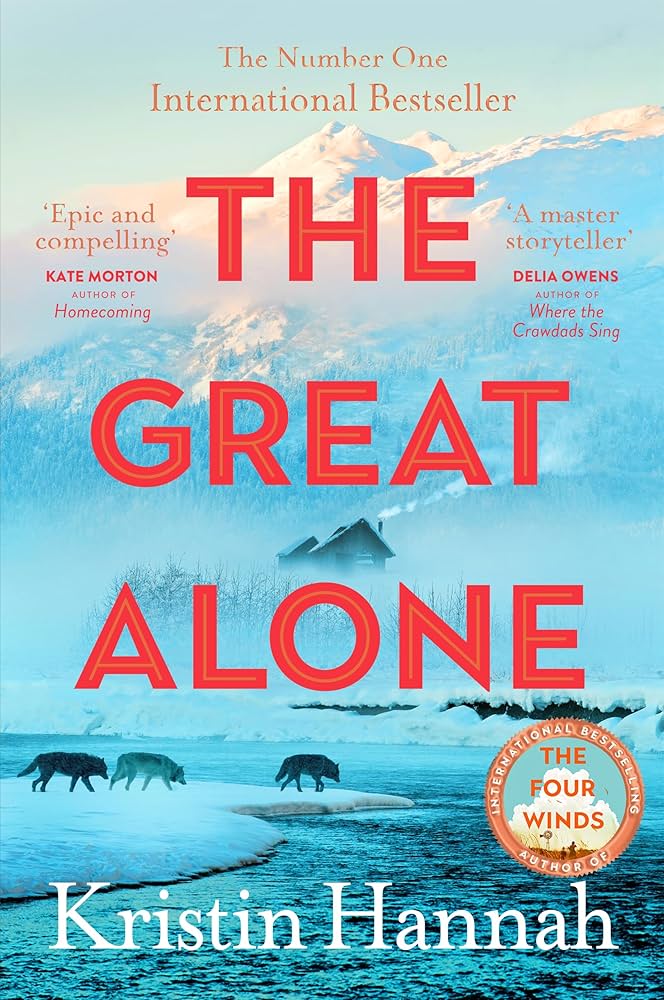
It will come as no surprise that Kristin Hannah is one of my favourite authors. With nine of her books read so far and two of them twice, her writing has ensured me that I will enjoy every on of her books and that I will cry at every one of her books. It is far too difficult for me to pick a favourite out of her masterpieces, but there are two that I have read twice already, and one of them is The Great Alone. It is a beautiful story about strength and resilience, and the beauty of Alaska is highlighted in such a wild and untamed way that feels refreshing. There are many themes, metaphors and things to discuss, so let’s get into it.
Plot
Lenny and her parents have been moving around ever since her father has come back from the war. The country is changing and so is her father, Ernt, whose restless spirit prevents the family from finally grounding somewhere. This time, he has inherited a plot of land from a friend up in Alaska, and he promises this is the fresh start they need. Away from the politics, away from the protests, away from the people ruining the country and away from society. The land of Alaska is wild, and living there is not for the fainthearted. But slowly, the three find their way in their new environment. As they learn to live from the land and self-provide, it seems her Lenny’s father is finally happy and their new home looks to be permanent. However, beautiful and wild as Alaska is, the outside sometimes reflects the wildness from within and when winter falls, darkness is all-encompassing. As Ernt’s mental state starts to deteriorate worse than ever, Lenny and her mother realise they will soon find out what is worse: the threats from the outside, or the dangers from inside.
Themes
There are a few themes that are quite prevalent in the book and that are important to the plot. For instance, the opposition of community versus self-sufficiency. When the family arrives in Alaska, they come there to live away from society and provide for themselves. At the same time though, they are wholly unprepared for what it truly takes to survive in the last frontier, and heavily rely on the help of the local community. Everyone comes together, helps build sheds, shares and trades foods and materials. So although people leave the masses behind, these places have the strongest communities I have ever read about. I found it perfectly showed how quality of relations is much more important than quantity, which was portrayed beautifully with the people of Kaneq.
Another important theme is resilience, which goes hand in hand with strength. These people have to be extremely tough to survive in extreme circumstances of darkness, cold and danger. Things don’t work from the first time, and new challenges arise every day in Alaska, which is where the people’s resilience really comes to the fore. Lenny and her mother especially deal with more than just their environment in surviving, but their strength and character makes them fit right in with the Alaskans. These two themes go hand in hand, because strong people can build an even stronger community, and a tight community with people helping and teaching each other makes for smart and resilient people.
Finally, I found symbolism in this book, a theme that heightened the reading experience. What Phoebe said about Wuthering Heights in Friends, applies for The Great Alone as well. The wildness of the land is clearly reflected in Ernts character, made even more apparent by the clear influence of the seasons on his mental state. When the days are long and the land flourishing, he is more patient and forbearing, but when winter starts creeping up the darkness creeps inside their home as well. This connection between Ernts character and the land made it more tangible for readers and conveyed the direness of the situation Lenny and her mother found theirselves in.
The Great Alone is another clear hit for me. It shows the strength people can find in themselves, the beauty of uncontrollable land and the unforgiving nature of, well, nature. How much forgiveness should we show the people we love, and what is the final straw that makes us say, no more? As all Kristin Hannah’s books, this is not merely a story about a family moving to Alaska, but rather a story about people coming together, building a community, and strong relationships. Beware, because it is a tearjerker, but one that will open your eyes to the beauty of the wild.
 Toni's Book Corner
Leave a comment